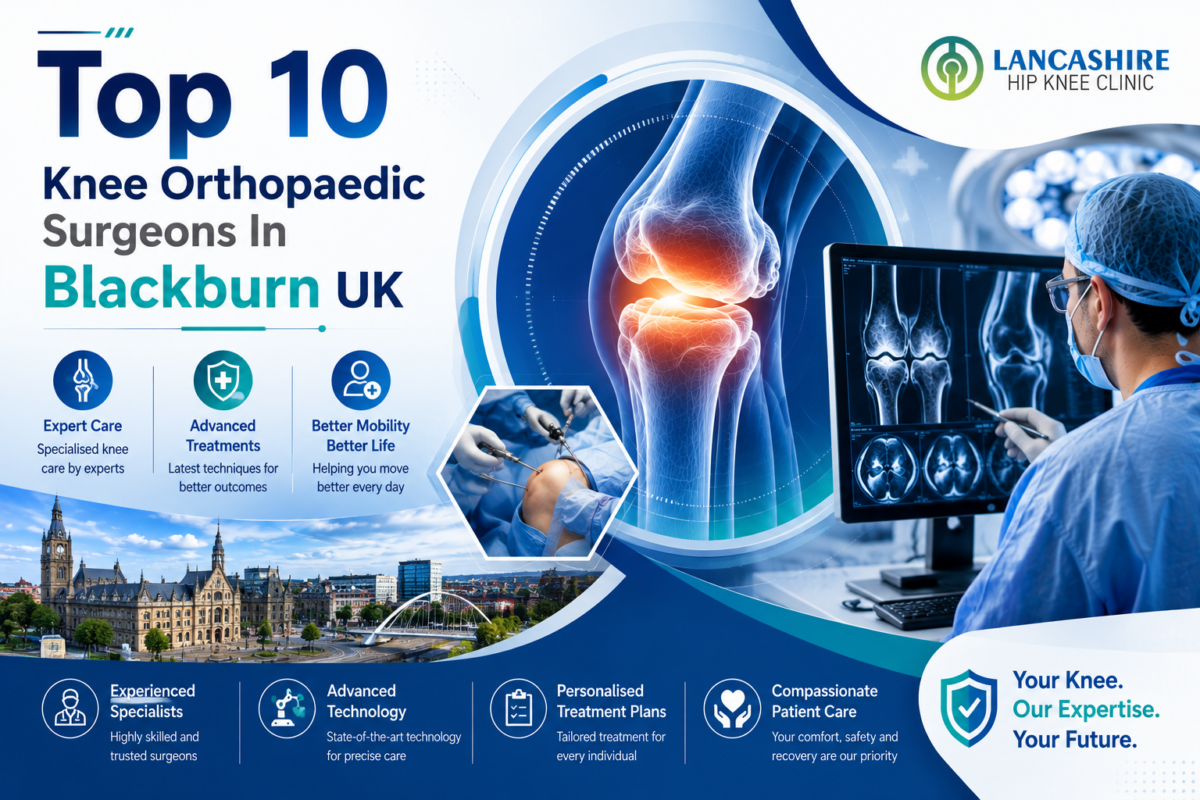

Finding the right knee specialist can feel like a difficult decision, especially when you have been living with knee pain for weeks, months or even years. Whether you are dealing with arthritis, a sports injury, a damaged meniscus or considering knee replacement surgery, choosing an experienced knee orthopaedic surgeon can make the treatment journey feel much clearer.
For people living in Blackburn, Lancashire and nearby areas, there are several experienced orthopaedic consultants who specialise in different aspects of knee care. Some focus heavily on knee replacement, while others have particular expertise in knee arthroscopy, sports injuries, ligament reconstruction, partial knee replacement or complex revision surgery.
This guide looks at 10 knee specialists who have a professional connection with Blackburn and whose published profiles show experience in knee-related treatment. It is not intended to be an official ranking. Instead, it is designed to help patients understand their options before deciding who they would like to consult.
1. Orthopaedic Surgeon Prof. Kuntal Patel
Professor Kuntal Patel is a Consultant Orthopaedic Surgeon with a specialist interest in lower limb surgery, including hip and knee conditions. He provides private consultations at The Beardwood Hospital in Blackburn, as well as practices in Lancaster and Blackpool.
His areas of expertise include knee replacement, knee arthroscopy, ACL reconstruction and arthritis of the knee. He also offers VELYS robotic-assisted knee replacement surgery. His professional profile states that he completed specialist orthopaedic training across several North West hospitals, including Blackburn and Wrightington, and later gained lower limb arthroplasty fellowship experience at Wrightington Hospital.
For patients considering total knee replacement, partial knee replacement or treatment for long-term knee arthritis, having a consultation with a specialist who regularly deals with lower limb problems can be useful.
Professor Patel is also the surgeon behind Lancashire Hip Knee Clinic, which provides specialist assessment and treatment for hip, knee and foot and ankle conditions. The clinic is based across Lancashire, with The Beardwood Hospital being its Blackburn location.
2. Mr Dinesh Alexander
Mr Dinesh Alexander is a Consultant Orthopaedic and VELYS robotic-assisted knee surgeon practising at The Beardwood Hospital in Blackburn.
His clinical interests include knee replacement, unicompartmental knee replacement, knee arthroscopy and revision hip and knee surgery. He also works as a Consultant Orthopaedic Surgeon with East Lancashire Hospitals across Blackburn and Burnley and has held the role of Clinical Director for Trauma and Orthopaedics at East Lancashire Hospitals.
His experience covers both straightforward and more complex knee replacement procedures. This can be particularly relevant for patients who want to understand whether traditional or robotic-assisted surgery may be appropriate for their condition.
3. Mr Amit Shah
Mr Amit Shah is an experienced Orthopaedic Surgeon practising at The Beardwood Hospital in Blackburn. His professional profile shows a particular interest in hip and knee surgery, including knee replacement and knee pain.
He has been involved in orthopaedics since 1998 and has extensive experience in the specialty. His Doctify profile also lists knee replacement and enhanced recovery knee replacement among his areas of expertise.
For someone looking for an experienced consultant to assess persistent knee pain or discuss whether knee replacement is appropriate, a detailed consultation is usually the best starting point rather than assuming surgery is automatically required.
4. Mr Ravi Goyal
Mr Ravi Goyal is a Consultant Orthopaedic Surgeon based at The Beardwood Hospital in Blackburn. His specialist interest is knee surgery, and his published profile lists knee replacement surgery, knee arthroscopy, meniscal surgery, ligament reconstruction and treatment for degenerative knee disorders.
He also has experience in ACL surgery and sports-related knee problems. His profile confirms that he works at The Beardwood Hospital in Blackburn, while National Joint Registry records show activity associated with Beardwood Private Hospital and Royal Blackburn Hospital.
This broad knee experience may be particularly relevant to patients whose symptoms are linked to sports injuries, ligament problems, meniscal damage or arthritis.
5. Mr Rajan Mohan
Mr Rajan Mohan is a Consultant Orthopaedic Surgeon at The Beardwood Hospital in Blackburn with more than 20 years of experience in orthopaedics and trauma.
His clinical interests include hip and knee arthroplasty, revision arthroplasty and unicompartmental knee replacement. He also has experience with arthroscopic procedures.
His experience with revision arthroplasty can be particularly important for patients who have already undergone a joint replacement and are experiencing problems with an existing implant.
6. Mr Sriranga Kamath
Mr Sriranga Kamath is an experienced Consultant Orthopaedic Surgeon with a subspecialist interest in hip and knee surgery. He practises at The Beardwood Hospital in Blackburn.
His published clinical interests include primary total knee replacement, custom total knee replacement, revision total knee replacement, partial medial and lateral unicompartmental knee replacement, patellofemoral joint replacement and knee arthroscopy.
This range of experience means his profile may be relevant to patients who are exploring different forms of surgical knee replacement, particularly where the condition is more complex or only part of the knee is affected.
7. Mr Syed Awais Bokhari
Mr Syed Awais Bokhari is a Consultant Trauma and Orthopaedic Surgeon practising at The Beardwood Hospital in Blackburn. His specialist interests include hip and knee replacement surgery, including primary, complex and revision procedures.
He also performs keyhole knee surgery for sports-related injuries. His training included a fellowship at Wrightington Hospital, where he developed further experience in complex primary and revision joint surgery.
For patients who have already had a knee replacement and may require revision knee arthroplasty, or for those with a more complicated joint problem, discussing the full range of treatment options with a suitably experienced consultant can be important.
8. Mr Rizwan Arshad
Mr Rizwan Arshad is a Consultant Trauma and Orthopaedic Surgeon at The Beardwood Hospital in Blackburn. His specialist training included a fellowship at Sheffield Children’s Hospital and Chesterfield Royal Hospital, where he developed expertise in paediatric, adolescent and adult knee problems.
His clinical interests include soft tissue reconstruction, ligament problems, knee arthroscopy, knee replacement surgery and sports injuries. He is also involved in teaching and research and serves as an MSK lead at East Lancashire Hospitals.
His background can be particularly relevant for younger patients and those with ligament, soft tissue or sports-related knee conditions.
9. Mr Jonathan Barrow
Mr Jonathan Barrow is a Consultant Orthopaedic Surgeon who practises at The Beardwood Hospital in Blackburn. His listed specialties include knee surgery and treatment for knee arthritis.
His clinical interests include primary hip and knee replacement, including day-case surgery, as well as complex revision hip replacement. He also has experience in arthroplasty and has contributed to peer-reviewed publications in the field.
For patients considering a knee replacement operation, understanding the reason for the procedure, expected benefits and possible recovery process is just as important as choosing the surgeon.
10. Mr Hans Marynissen
Mr Hans Marynissen is a Consultant Trauma and Orthopaedic Surgeon with a long-standing professional connection to East Lancashire. His NHS practice includes Blackburn, Burnley and Rossendale, and he also holds private practice privileges at The Beardwood Hospital.
He developed a specialist interest in shoulder and knee pathology through further fellowship training and has experience in knee replacement care. Current PHIN information reports patient feedback in which 100% of 64 respondents said they were extremely likely or likely to recommend him.
As with any consultant, patients should consider their own diagnosis, treatment requirements and personal preferences when deciding whether a particular surgeon is right for them.
How Do You Know If You Need Knee Replacement?
Not every painful knee needs surgery.
Knee pain can happen for many different reasons. Arthritis is one of the most common, but meniscal injuries, ligament problems, inflammation, previous injuries and other conditions can also cause symptoms.
If your knee swelled up and hurts, it is worth finding out why rather than immediately assuming that you need a knee replacement. Common knee swelling causes include injury, arthritis, inflammation and fluid build-up. Swelling can also occur behind the knee, sometimes resulting in a noticeable lump or tight feeling.
There are many possible puffy knees causes, so a proper assessment is important.
A knee specialist may examine the joint, ask about your symptoms and medical history, and arrange imaging such as an X-ray or MRI when appropriate. The aim is to understand what is actually causing the pain before recommending treatment.
Total Knee Replacement or Partial Knee Replacement?
One of the questions patients often ask is whether they need a total knee replacement or a partial knee replacement.
A total knee replacement replaces the damaged surfaces of the main parts of the knee joint. It may be considered when arthritis or damage affects several areas of the knee and symptoms have become severe enough to affect everyday life.
A partial uni knee replacement, also known as a unicompartmental knee replacement, is different. It replaces only the damaged compartment of the knee while preserving healthier parts of the joint.
However, not everyone is suitable for partial surgery. Partial knee replacement eligibility depends on factors such as where the arthritis is located, the condition of the remaining parts of the knee, ligament stability, symptoms and overall joint function.
That is why reading a partial knee replacement guide online can help you understand the basics, but it cannot replace an individual assessment by a knee specialist.
What About Knee Arthroscopy?
Knee arthroscopy is a minimally invasive procedure in which a small camera is inserted into the knee through small incisions.
It may be used for certain meniscal, cartilage, ligament or other internal knee problems. Whether arthroscopy is appropriate depends on the underlying condition. It is not automatically the right treatment for every person with knee pain.
A good consultation should explain why a particular procedure is being suggested and whether non-surgical options should be considered first.
What Is Revision Knee Arthroplasty?
Sometimes a previous knee replacement develops a problem and further surgery becomes necessary. This may be referred to as revision knee arthroplasty.
Revision surgery can be more complex than a first knee replacement because the surgeon may need to deal with issues involving the existing implant, bone quality, instability, infection or wear.
For this reason, patients considering revision surgery should look for a consultant with appropriate experience in complex and revision joint replacement.
What Is the Knee Replacement Recovery Time?
There is no single answer to knee replacement recovery time because every patient is different.
Your age, general fitness, muscle strength, the condition of your knee before surgery, the type of procedure performed and your rehabilitation can all affect recovery.
Many people begin walking soon after surgery with support and gradually increase their activity. Physiotherapy and regular exercises are important parts of knee replacement recovery.
Rather than asking only, “How quickly will I recover?”, it can be more useful to ask your surgeon what recovery is likely to look like in your particular situation.
Choosing the Right Knee Orthopaedic Surgeon in Blackburn
Choosing between different knee orthopaedic surgeons is not simply about finding the person with the longest list of qualifications.
You should feel comfortable asking questions.
Ask what is causing your knee problem. Ask whether surgery is genuinely necessary. If replacement is recommended, ask why a total or partial replacement is more suitable for you. If you have already had surgery, ask what could be causing your current symptoms and whether revision surgery is necessary.
It is also reasonable to ask about expected knee replacement recovery, possible complications, rehabilitation and when you may be able to return to normal activities.
Most importantly, you should feel that your consultant has listened to you.
When Should You Seek Help for Knee Pain?
If knee pain is stopping you from walking normally, disturbing your sleep, making stairs difficult or preventing you from doing activities you previously enjoyed, it may be time to seek professional advice.
You should also speak to a healthcare professional if you have persistent swelling, repeated episodes of your knee giving way, locking, significant stiffness or pain that does not improve with reasonable self-care.
A swollen knee can have several causes, so getting an accurate diagnosis is more useful than simply treating the symptom.
Book an Appointment With Lancashire Hip & Knee Clinic
For people in Blackburn, Blackpool, Lancaster and across Lancashire, specialist assessment can help you understand what is happening inside your knee and what treatment options may be suitable.
Lancashire Hip & Knee Clinic provides specialist orthopaedic assessment and treatment for hip, knee and foot and ankle conditions. Professor Kuntal Patel is a Consultant Orthopaedic Surgeon with a particular interest in lower limb surgery, including knee replacement and knee arthroscopy. The clinic’s Blackburn practice is based at The Beardwood Hospital.
If you are considering knee replacement surgery, have ongoing knee pain or want to understand whether a partial or total replacement may be appropriate, you can book an appointment for a professional assessment.
A consultation is not simply about deciding whether you need surgery. It is about understanding your knee, discussing your options and choosing a treatment approach that makes sense for you.
For many patients, having that conversation is the first step towards getting back to walking, working, exercising and enjoying everyday life with greater confidence.
Final Thoughts
There are several experienced knee specialists available to patients in Blackburn and the wider Lancashire area. The right choice will depend on your specific condition, the type of treatment you may need and the experience of the consultant in that particular area.
Whether you are researching total knee replacement, partial knee replacement, knee arthroscopy or revision surgery, do not feel pressured to make a decision based only on a name or online ranking.
Take the time to understand your diagnosis, ask questions and discuss your treatment options with a qualified orthopaedic specialist.
For patients looking for specialist knee care in Blackburn and across Lancashire, Lancashire Hip & Knee Clinic can provide an opportunity to discuss your symptoms and treatment options with Professor Kuntal Patel.
FAQs
1. How do I choose the right knee orthopaedic surgeon in Blackburn?
Look for a consultant with relevant experience in your specific knee condition and the treatment you may need. It is also important to discuss your diagnosis, treatment options, expected results and recovery before making a decision.
2. When is a total knee replacement recommended?
A total knee replacement may be considered when severe knee arthritis or joint damage causes ongoing pain, stiffness and difficulty with everyday activities, particularly when other treatments have not provided enough relief.
3. Am I suitable for a partial knee replacement?
Partial knee replacement eligibility depends on several factors, including where the damage is located, the condition of the other parts of your knee and the stability of your ligaments. Your surgeon can assess whether it is suitable for you.
4. How long does knee replacement recovery take?
Knee replacement recovery time varies from person to person. Many patients start walking with support soon after surgery, but returning to normal activities can take several weeks or longer depending on individual circumstances and rehabilitation.
5. What causes knee swelling and pain?
There are several possible knee swelling causes, including arthritis, injuries, inflammation and fluid build-up. Swelling behind the knee can also have different causes, so persistent or unexplained swelling should be assessed by a healthcare professional.
6. Can I avoid knee replacement surgery?
In some cases, knee replacement may not be necessary. Depending on the cause and severity of your symptoms, treatment may include physiotherapy, exercise, medication, weight management or other non-surgical options. A knee specialist can help you understand which approach is appropriate for your condition.