

Knee pain can affect far more than just your ability to walk. A swollen knee may make stairs uncomfortable, a damaged meniscus can interfere with everyday movement, and arthritis can gradually make simple activities feel like hard work. When pain continues despite non-surgical treatment, seeing an experienced knee orthopaedic surgeon can help you understand what is happening and what options may be available.
For people searching for knee orthopaedic surgeons in Blackpool, there are several consultants working across Blackpool and the wider Lancashire area. Their areas of interest vary, from knee arthroscopy and sports injuries to total knee replacement, partial knee replacement and revision surgery.
This guide highlights 10 surgeons with a professional connection to Blackpool and documented experience in orthopaedic or knee-related care. It is not an official ranking or recommendation. Instead, it is intended to give patients a useful starting point when researching their options.
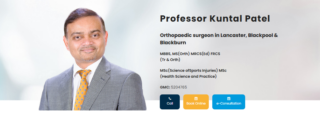
1. Orthopaedic Surgeon Prof. Kuntal Patel
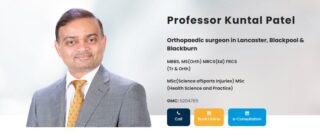
Orthopaedic Surgeon Prof. Kuntal Patel is a Consultant Orthopaedic Surgeon with a particular interest in lower limb surgery, including conditions affecting the hip, knee and foot/ankle. He sees patients in Blackpool, Blackburn and Lancaster, including at Spire Fylde Coast Hospital in Blackpool.
His areas of expertise include total knee replacement, partial knee replacement, knee arthroscopy, ACL reconstruction, sports injuries and arthritis. He has also completed fellowship training in lower limb arthroplasty at Wrightington Hospital and has experience with complex revision arthroplasty.
Through Lancashire Hip Knee Clinic, patients can receive assessment and treatment planning based on their individual condition rather than automatically being directed towards surgery. The clinic provides knee services in Blackpool, Blackburn and Lancaster.
2. Mr Arshad Javed
Mr Arshad Javed is a Consultant Orthopaedic Surgeon at Blackpool Victoria Hospital and has worked there since 2001. His practice includes hip and knee surgery, with particular interests in revision knee surgery, knee arthroscopy and sports injuries.
He also has a longstanding association with Spire Fylde Coast Hospital. His professional profile describes hip and knee surgery as key areas of his practice, making him relevant to patients researching knee specialists in Blackpool.
3. Mr Paul David Dunkow
Mr Paul David Dunkow is an orthopaedic consultant practising at Spire Fylde Coast Hospital in Blackpool. His work covers a broad range of knee conditions and procedures.
His specialist areas include total knee replacement, unicondylar knee replacement, revision knee replacement, knee arthroscopy, ACL reconstruction and meniscal procedures. His background also includes specialist fellowship training in knee replacement and arthroscopic knee surgery.
This range can be particularly relevant for patients who want to understand whether their symptoms require a knee replacement operation or whether another form of knee surgery may be more appropriate.
4. Mr Stephen Mannion
Mr Stephen Mannion is a Consultant Orthopaedic Surgeon with a long-standing connection to Blackpool. He practises at Spire Fylde Coast Hospital and has a special interest in lower limb arthroplasty and knee arthroscopy.
His professional information lists knee replacement surgery, arthroscopic knee surgery and hip replacement amongst his areas of practice. The National Joint Registry also records his activity at Blackpool Victoria Hospital and Spire Fylde Coast Hospital.
5. Mr Brijesh Ayyaswamy
Mr Brijesh Ayyaswamy is a Consultant Trauma and Orthopaedic Surgeon associated with Blackpool Teaching Hospitals and Spire Fylde Coast Hospital.
His clinical interests include knee surgery, lower limb arthroplasty, knee replacement and knee arthroscopy, alongside foot and ankle surgery. His professional profile states that he has more than two decades of experience in orthopaedics.
For someone looking for an orthopaedic surgeon who treats both routine and more complex lower-limb problems, his published profile provides useful information to consider.
6. Mr Anoop Anand
Mr Anoop Anand is an experienced Consultant Orthopaedic Surgeon who has worked at Blackpool Victoria Hospital since the mid-2000s.
His practice includes hip, knee and foot and ankle surgery, with experience in lower limb arthroplasty. His professional profile also identifies hip and knee care among his principal areas of practice.
Patients considering knee treatment can discuss their symptoms and investigations with a specialist before deciding whether further conservative treatment, arthroscopy or replacement surgery is appropriate.
7. Mr Amit Bipin Shah
Mr Amit Bipin Shah is another consultant with recorded orthopaedic activity at Blackpool Victoria Hospital and several hospitals across Lancashire.
National Joint Registry information identifies his specialist areas as including primary total knee replacement and revision knee replacement, alongside hip replacement procedures. His recorded activity includes Blackpool Victoria Hospital and Spire Fylde Coast Hospital.
For patients researching revision knee arthroplasty, understanding a surgeon’s experience with revision procedures can be an important part of the consultation process.
8. Mr Rafik Ragaei Daoud Yassa
Mr Rafik Ragaei Daoud Yassa has recorded knee replacement activity at Blackpool Victoria Hospital. The National Joint Registry identifies primary total knee replacement and primary unicondylar (partial) knee replacement among his specialist areas.
His recent registry data also records activity in both total and unicondylar knee replacement procedures.
This is relevant for patients researching the difference between a full knee replacement and a partial or unicompartmental procedure.
9. Mr Moorthy Srinivas
Mr Moorthy Srinivas is a consultant whose National Joint Registry activity includes Blackpool Victoria Hospital. Recent registry information records activity in total knee replacement as well as hip and elbow procedures.
Patients considering surgery should still have an individual assessment, as the appropriate treatment depends on factors such as the location and severity of joint damage, symptoms, mobility, previous treatment and overall health.
10. Mr Hinesh Devendra Bhatt
Mr Hinesh Devendra Bhatt has recorded joint replacement activity at Blackpool Victoria Hospital. National Joint Registry information identifies primary total knee replacement and primary hip replacement among his specialist areas.
Recent registry data also records both total and unicondylar knee replacement activity.
For anyone researching knee replacement surgeons, publicly available registry information can provide useful background, but it should be considered alongside a consultant’s current practice, specific expertise and the patient’s individual circumstances.
How Do You Choose a Knee Orthopaedic Surgeon?
Finding a surgeon is not simply about choosing the first name that appears online. Your knee problem may be very different from someone else’s, so the most appropriate specialist will depend on your diagnosis and treatment requirements.
Before booking a consultation, consider:
- Does the surgeon regularly treat your particular knee condition?
- Do they perform the procedure you have been advised to consider?
- Are they experienced in total knee replacement or partial knee replacement if replacement has been discussed?
- Do they treat sports injuries and meniscal or ligament problems if these are relevant to you?
- Can they explain non-surgical options as well as surgery?
- Where do they carry out consultations and operations?
- What should you realistically expect from knee replacement recovery time?
It is also worth asking what happens after surgery. Recovery is not just about the operation itself. Physiotherapy, mobility, wound care, pain management and gradually returning to normal activities all form part of the process.
When Should You See a Knee Specialist?
Not every painful or knee swelled up and hurts episode means that surgery is required. Swelling can have several causes, including injury, arthritis and inflammation, and the right treatment depends on the underlying problem.
However, persistent pain, repeated swelling, instability, restricted movement or difficulty walking can be reasons to seek professional assessment. A specialist may recommend imaging or other investigations before discussing treatment.
For people considering surgery knee replacement, it is particularly important to understand why replacement has been suggested, what alternatives may exist and whether a total or partial procedure is appropriate.
Knee Care Across Blackpool, Blackburn and Lancaster
For patients looking for specialist knee care across Lancashire, Lancashire Hip Knee Clinic provides consultations with Prof. Kuntal Patel in Blackpool, Blackburn and Lancaster. The clinic’s services include knee replacement and knee arthroscopy, alongside treatment for other hip and lower-limb conditions.
Prof. Patel currently practises at Spire Fylde Coast Hospital in Blackpool, The Beardwood Hospital in Blackburn and The Lancaster Hospital, giving patients across the region access to specialist lower-limb orthopaedic care.
If ongoing knee pain is affecting your everyday life, a consultation can help you understand the cause and discuss the treatment options available. Rather than assuming that total knee replacement surgery is the answer, a specialist assessment can help determine whether physiotherapy, medication, injections, knee arthroscopy, partial replacement or another approach may be suitable.
Book an appointment with Lancashire Hip Knee Clinic to discuss your knee symptoms and treatment options with Orthopaedic Surgeon Prof. Kuntal Patel in Blackpool, Blackburn or Lancaster.
FAQs
1. How do I choose a knee orthopaedic surgeon in Blackpool?
Consider the surgeon’s experience with your specific knee condition, the procedures they perform, their hospital affiliations and whether they offer both non-surgical and surgical treatment options.
2. When should I see a knee orthopaedic surgeon?
You may want to seek specialist assessment if knee pain persists, swelling keeps returning, movement becomes restricted, or you experience instability or difficulty walking despite initial treatment.
3. What knee conditions can an orthopaedic surgeon treat?
Knee orthopaedic surgeons can assess and treat conditions such as osteoarthritis, meniscus injuries, ligament problems, sports injuries and joint damage. Treatment may include physiotherapy, injections, arthroscopy or knee replacement, depending on the diagnosis.
4. What is the difference between total and partial knee replacement?
A total knee replacement replaces the damaged surfaces of the whole knee joint, while a partial knee replacement replaces only the damaged compartment. Your suitability depends on the extent and location of joint damage.
5. Do all knee problems require surgery?
No. Depending on the underlying condition, treatment may include physiotherapy, medication, activity modification or injections. Surgery is generally considered when symptoms remain significant and other appropriate treatments have not provided sufficient relief.
6.Where can I find specialist knee care in Blackpool?
Patients seeking specialist knee care in Blackpool can arrange a consultation with Prof. Kuntal Patel through Lancashire Hip Knee Clinic. Consultations are also available in Blackburn and Lancaster, with treatment options discussed according to the individual patient’s condition.